
 French
  Deutschland
  English
  الإمارات
  Spanish
 The scarf manufacturing industry is experiencing a technological revolution. From AI-generated patterns and duplex digital printing to waterless dyeing systems and supercritical CO₂ technology, modern scarf production is becoming faster, more sustainable, and more customizable than ever before.
As fashion brands, retailers, wholesalers, and luxury accessory companies seek innovative ways to differentiate their products, the adoption of advanced printing technologies has become a key competitive advantage. Today’s buyers expect high-resolution designs, sustainable production methods, faster turnaround times, and flexible order quantities.
For manufacturers and suppliers, understanding the latest scarf printing technologies is essential for staying ahead in an increasingly competitive global market. Companies like Woolgold, a leading scarf manufacturer in India, are integrating advanced digital printing, hand embroidery, jacquard weaving, and sustainable production methods to serve fashion brands worldwide.
Why Scarf Printing Technology Matters
Modern scarf printing technology directly impacts:
- Design quality
- Production speed
- Sustainability
- Customization options
- Color accuracy
- Cost efficiency
- Minimum order quantities
- Customer satisfaction
Luxury fashion brands increasingly demand printing methods capable of producing intricate artwork, photographic patterns, vibrant colors, and sustainable production outcomes.
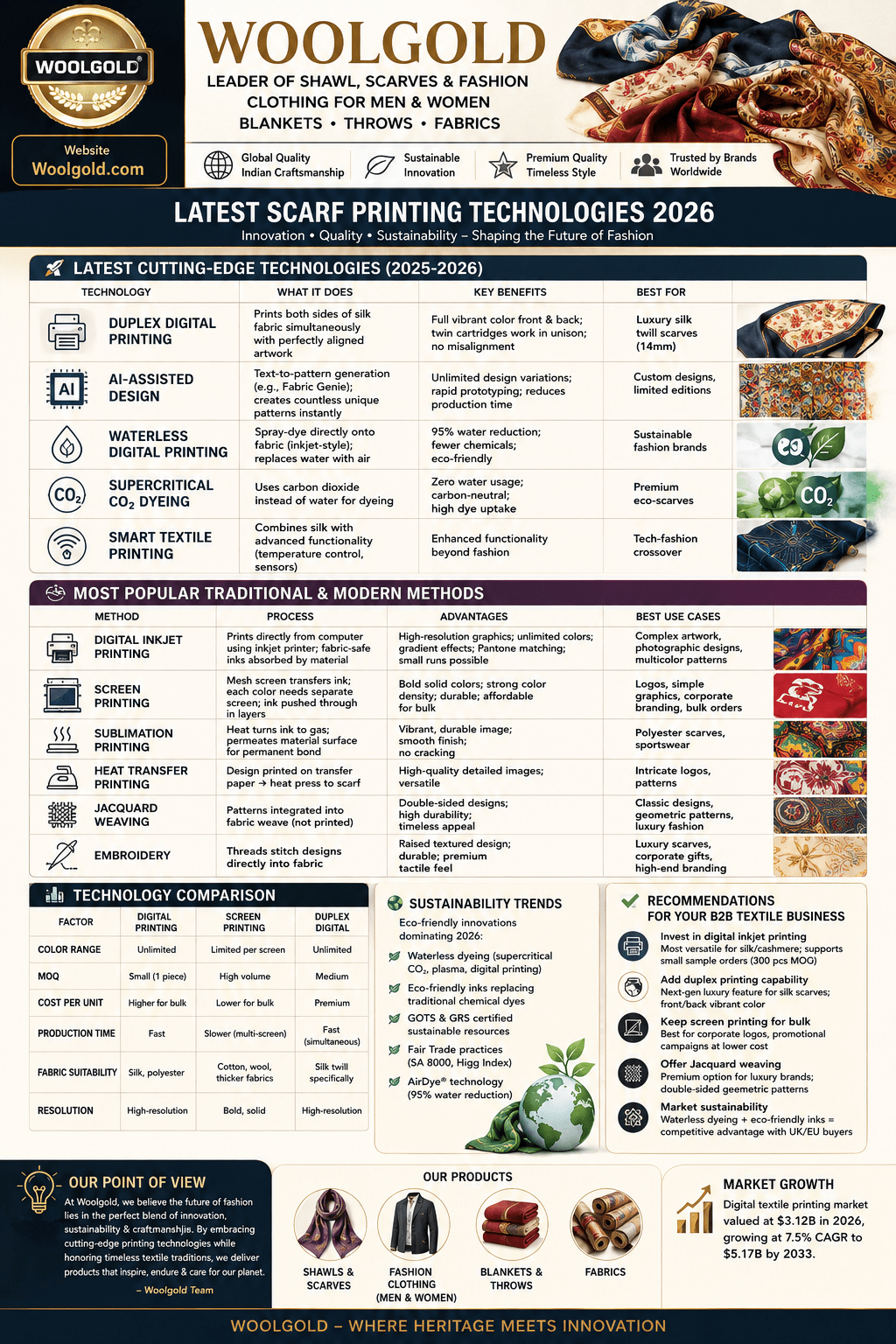
The Evolution of Scarf Printing
Traditional scarf production relied heavily on manual processes such as screen printing and hand painting. While these methods remain relevant, technological innovation has introduced new possibilities that combine creativity with manufacturing efficiency.
Today’s leading scarf manufacturers utilize:
- Digital textile printing
- AI-assisted design systems
- Waterless printing technologies
- Duplex printing systems
- Sustainable dyeing methods
- Smart textile applications
These innovations are reshaping the future of textile manufacturing.
Duplex Digital Printing: The Luxury Game-Changer
One of the most exciting innovations in 2026 is Duplex Digital Printing.
What is Duplex Digital Printing?
This advanced technology prints both sides of a silk scarf simultaneously while maintaining perfect alignment between front and back designs.
Unlike traditional methods, duplex printing uses synchronized twin print systems that work together to eliminate design mismatches.
Key Benefits
- Vibrant colors on both sides
- Perfect artwork alignment
- Luxury appearance
- Premium finish
- Faster production
- Enhanced customer perception
Best Applications
Duplex digital printing is particularly suitable for:
- Luxury silk twill scarves
- Designer fashion collections
- Premium gifting products
- High-end retail brands
Luxury brands increasingly prefer duplex printing because consumers often view both sides of a scarf while styling it.
AI-Assisted Design Technology
Artificial Intelligence is revolutionizing scarf design development.
How AI-Assisted Design Works
Modern AI tools can generate unique textile patterns from simple text prompts.
Designers can create:
- Floral motifs
- Geometric patterns
- Abstract artwork
- Luxury prints
- Seasonal collections
Within minutes, AI platforms generate hundreds of design variations that previously required weeks of manual work.
Benefits for Fashion Brands
- Faster design creation
- Unlimited creativity
- Reduced development costs
- Rapid prototyping
- Easier customization
AI-generated scarf collections are becoming increasingly popular among private-label brands and fashion startups.
Waterless Digital Printing
Sustainability is becoming one of the biggest priorities in textile manufacturing.
What is Waterless Digital Printing?
Waterless digital printing uses advanced spray-dye technology that applies color directly to fabric without the excessive water consumption associated with traditional dyeing methods.
Advantages
- Up to 95% reduction in water usage
- Lower chemical consumption
- Reduced environmental impact
- Faster production
- Improved sustainability credentials
Ideal For
- Sustainable fashion brands
- Eco-conscious retailers
- Luxury textile manufacturers
- Green fashion collections
As environmental regulations become stricter, waterless printing is expected to become a standard industry practice.
Supercritical CO₂ Dyeing Technology
Perhaps the most environmentally advanced innovation in textile manufacturing is Supercritical CO₂ Dyeing.
How It Works
Instead of water, this technology uses carbon dioxide under controlled pressure to transfer dye into textile fibers.
Benefits
- Zero water usage
- Carbon-neutral production potential
- High dye absorption rates
- Minimal waste generation
- Superior color consistency
Best Applications
- Premium sustainable scarves
- Luxury eco-fashion collections
- High-performance textile products
This technology represents the future of environmentally responsible textile manufacturing.
Smart Textile Printing
The boundary between fashion and technology continues to blur.
What is Smart Textile Printing?
Smart textile printing combines traditional fabrics with advanced functionalities such as:
- Temperature regulation
- Sensor integration
- Moisture management
- Interactive textile features
Emerging Opportunities
Although still a niche market, smart scarves are gaining attention among:
- Luxury technology brands
- Wearable technology companies
- Fashion innovators
This category is expected to grow significantly over the next decade.
Digital Inkjet Printing: The Industry Standard
Despite emerging innovations, Digital Inkjet Printing remains the most versatile and widely used scarf printing technology.
How Digital Inkjet Printing Works
Designs are printed directly onto fabric using specialized textile-safe inks controlled by computer software.
Advantages
- Unlimited color options
- High-resolution graphics
- Photographic-quality printing
- Pantone color matching
- Small production runs
- Fast turnaround times
Ideal Applications
- Silk scarves
- Cashmere scarves
- Wool scarves
- Fashion collections
- Custom branded products
Digital printing is especially popular among brands seeking flexibility and premium visual quality.
Screen Printing: Still Essential for Bulk Orders
Screen printing continues to play a critical role in commercial scarf manufacturing.
How Screen Printing Works
Ink passes through a mesh screen onto fabric. Each color requires a separate screen, creating bold and durable designs.
Advantages
- Strong color density
- Cost-effective for large orders
- Long-lasting prints
- Excellent color saturation
Best Applications
- Corporate branding
- Promotional scarves
- Bulk retail orders
- Simple logo designs
While digital printing dominates small and medium runs, screen printing remains highly efficient for high-volume production.
Sublimation Printing
Sublimation printing remains a popular choice for synthetic fabrics.
Process
Heat transforms ink into gas, allowing it to penetrate the fabric surface permanently.
Benefits
- Vibrant colors
- Exceptional durability
- No cracking or peeling
- Smooth fabric feel
Best For
- Polyester scarves
- Sports scarves
- Performance accessories
Heat Transfer Printing
Heat transfer printing provides excellent versatility for custom scarf production.
Advantages
- Detailed image reproduction
- Flexible customization
- Cost-effective short runs
- Fast setup
Applications
- Promotional products
- Corporate gifts
- Fashion accessories
- Customized branding
Jacquard Weaving: Beyond Printing
While not technically a printing method, jacquard weaving remains one of the most luxurious decoration techniques available.
What Makes Jacquard Special?
Patterns are woven directly into the fabric rather than printed on the surface.
Benefits
- Double-sided designs
- Exceptional durability
- Luxury appearance
- Timeless aesthetic
Best Uses
- Premium fashion scarves
- Geometric patterns
- Luxury retail collections
Many luxury brands prefer jacquard scarves because of their sophisticated appearance and long lifespan.
Embroidery for Premium Branding
Embroidery remains one of the most prestigious scarf customization methods.
Advantages
- Raised texture
- Premium tactile feel
- Exceptional durability
- Luxury brand perception
Best Applications
- Corporate gifting
- Luxury branding
- Designer collections
- Exclusive product lines
Hand embroidery is particularly popular in premium fashion markets.
Technology Comparison for B2B Buyers
Digital Printing
Best For:
- Small MOQ orders
- Complex artwork
- Unlimited color designs
- Fast sampling
Screen Printing
Best For:
- Bulk production
- Corporate branding
- Cost-efficient manufacturing
Duplex Digital Printing
Best For:
- Luxury silk scarves
- High-end fashion collections
- Premium retail markets
Manufacturers serving multiple market segments often invest in all three technologies.
Sustainability Trends Driving the Future
The scarf industry is increasingly moving toward environmentally responsible production methods.
Key Sustainability Innovations
Waterless Dyeing
Technologies such as:
- Supercritical CO₂ dyeing
- AirDye® systems
- Waterless digital printing
are dramatically reducing water consumption.
Eco-Friendly Inks
Manufacturers are replacing traditional chemical dyes with environmentally safer alternatives.
Certified Sustainable Resources
Growing demand for:
- GOTS-certified materials
- GRS-certified recycled fibers
- Ethical sourcing programs
is reshaping supplier requirements worldwide.
Fair Trade Manufacturing
Standards such as:
- SA8000
- Higg Index compliance
are becoming increasingly important for international buyers.
What B2B Buyers Should Invest In
For fashion brands, retailers, and wholesalers sourcing scarves in 2026, the most strategic technologies include:
Digital Inkjet Printing
The most versatile solution for silk, wool, and cashmere scarves.
Duplex Printing
A premium differentiator for luxury collections.
Screen Printing
Essential for cost-effective bulk production.
Jacquard Weaving
A valuable addition for high-end luxury brands.
Sustainable Production Technologies
Increasingly important for UK, European, and North American buyers.
Future of Scarf Printing Technology
The global digital textile printing market is projected to continue strong growth through the next decade as brands increasingly prioritize:
- Personalization
- Sustainability
- Faster production
- AI-driven design
- Small-batch manufacturing
- Luxury customization
The future belongs to manufacturers that successfully combine digital precision, artisan craftsmanship, and eco-friendly innovation.
Conclusion
Scarf printing technology is evolving rapidly, offering unprecedented opportunities for brands, retailers, and manufacturers. From AI-assisted design and duplex digital printing to waterless dyeing and sustainable textile solutions, the industry is moving toward greater customization, higher quality, and reduced environmental impact.
Businesses that adopt advanced printing technologies can achieve stronger market differentiation, improved sustainability credentials, and greater flexibility in serving modern fashion consumers.
At Woolgold, we stay at the forefront of scarf manufacturing innovation by offering advanced digital inkjet printing, screen printing, jacquard weaving, hand embroidery, luxury finishing, and custom OEM/ODM production. As a leading scarf manufacturer in India, we provide worldwide delivery, premium silk, cashmere, wool, modal, linen, cotton, and polyester scarves tailored for global fashion brands, retailers, wholesalers, and corporate buyers. Our expertise extends beyond scarves to shawls, throws, blankets, kimonos, abayas, cord sets, and men’s and women’s clothing, combining craftsmanship, technology, and sustainable production solutions for the modern textile industry.