
 French
  Deutsch
  Spanish
  الإمارات
  English
  Dutch
Dutch  English
 Scarf pricing varies dramatically across market segments, materials, and geographies, ranging from as little as $12 for fast-fashion cotton scarves to over $1,000 for luxury cashmere or pashmina pieces. Understanding these price determinants is essential whether you’re purchasing as a consumer or sourcing as a wholesale buyer in India’s textile market.
Global Retail Market Pricing
Budget and Fast-Fashion Segment
Mass-market retailers like H&M and basic online platforms offer scarves in the $12-25 range for simple cotton or polyester-blend designs. These typically feature minimal embellishment and standard manufacturing. Cotton blends can extend to the $30-50 range with slightly better quality construction.
Mid-Range Retail
Department stores like Nordstrom and contemporary brands position scarves between $50-280. In this segment, you’ll find quality wool blends ($100-200), basic silk options ($150-350), and branded mid-tier offerings from companies like Coach ($95-228), MANGO ($119), and AllSaints ($128-240).
Premium and Luxury Segment
Luxury brands command substantially higher prices. Burberry ranges from $475-1,050 for their cashmere and wool silk offerings. Hermès silk scarves (Carrés) average $600-700 for new pieces, with their Twilly scarves at approximately $300. Acne Studios wool and mohair scarves range from $190-750, while Louis Vuitton scarves span $505-3,205. The most expensive pieces reach extraordinary levels—the Henri Matisse x Zika Ascher scarf sold for $4.8 million, though this represents a unique artist collaboration.
Scarf Pricing by Material and Market Segment (USD)
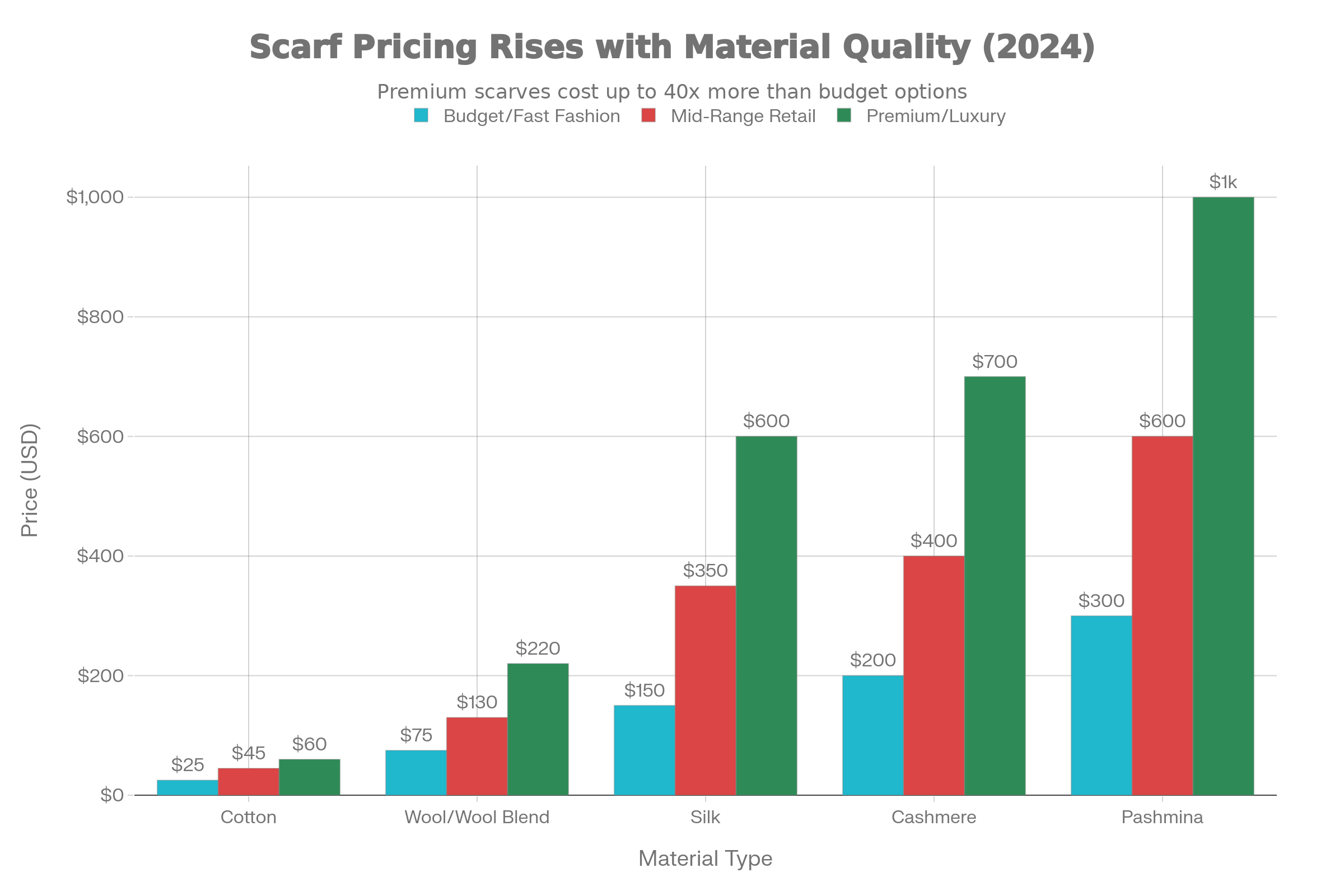
Material Impact on Pricing
Material quality creates the most significant price variation. Silk scarves typically retail between $100-600, depending on quality grade and brand. Pure mulberry silk commands premium prices due to its smooth texture and durability, with luxury brands charging $300-700 for authenticated pieces.
Cashmere scarves range from $95 at budget retailers like Gobi Cashmere to $1,050+ at luxury houses like Burberry. The premium reflects the fiber’s softness, warmth, and durability compared to synthetic alternatives.
Pashmina and Kashmiri wool represent the highest-end natural fiber scarves. Authentic hand-woven Kashmiri pashmina starts at ₹5,000 (approximately $60 USD) for basic pieces but can exceed ₹1,00,000 (over $1,200 USD) for premium handcrafted pieces with intricate embroidery. The price escalation reflects the artisanal weaving process, which can take up to 2 years per scarf.
Indian Market Pricing
Given your textile business background in India, local market pricing shows distinct advantages for wholesale procurement.
Retail Pricing in India
H&M India prices scarves between ₹699-5,499, while budget retail options range from ₹200-800. Designer scarves on platforms like Flipkart average ₹248-900, and premium Indian designer brands position pieces at ₹849-1,500.
Fine cotton stoles command ₹1,900-2,300, while merino wool stoles reach ₹3,500. The significantly lower Indian retail prices compared to global markets reflect both lower manufacturing costs and reduced retail markups in the domestic market.
Wholesale and Manufacturing Costs
India’s wholesale market provides substantial cost advantages. Major wholesale suppliers offer sample packs with minimal order quantities:

- Silver Pack: $550 for 50 scarves (~$11 per unit, MSRP $1,380)
- Gold Pack: $1,350 for 100 scarves (~$13.50 per unit, MSRP $2,910)
- Platinum Pack: $1,999 for 160 scarves (~$12.50 per unit, MSRP $5,830)
These packs include viscose, modal, cotton, silk, and Kashmiri pashmina options.
IndiaMART wholesale pricing for wool scarves starts at ₹850 per piece, with premium offerings reaching ₹1,250+. Cotton and polyester blends can be sourced as low as ₹150-300 per piece in bulk orders.
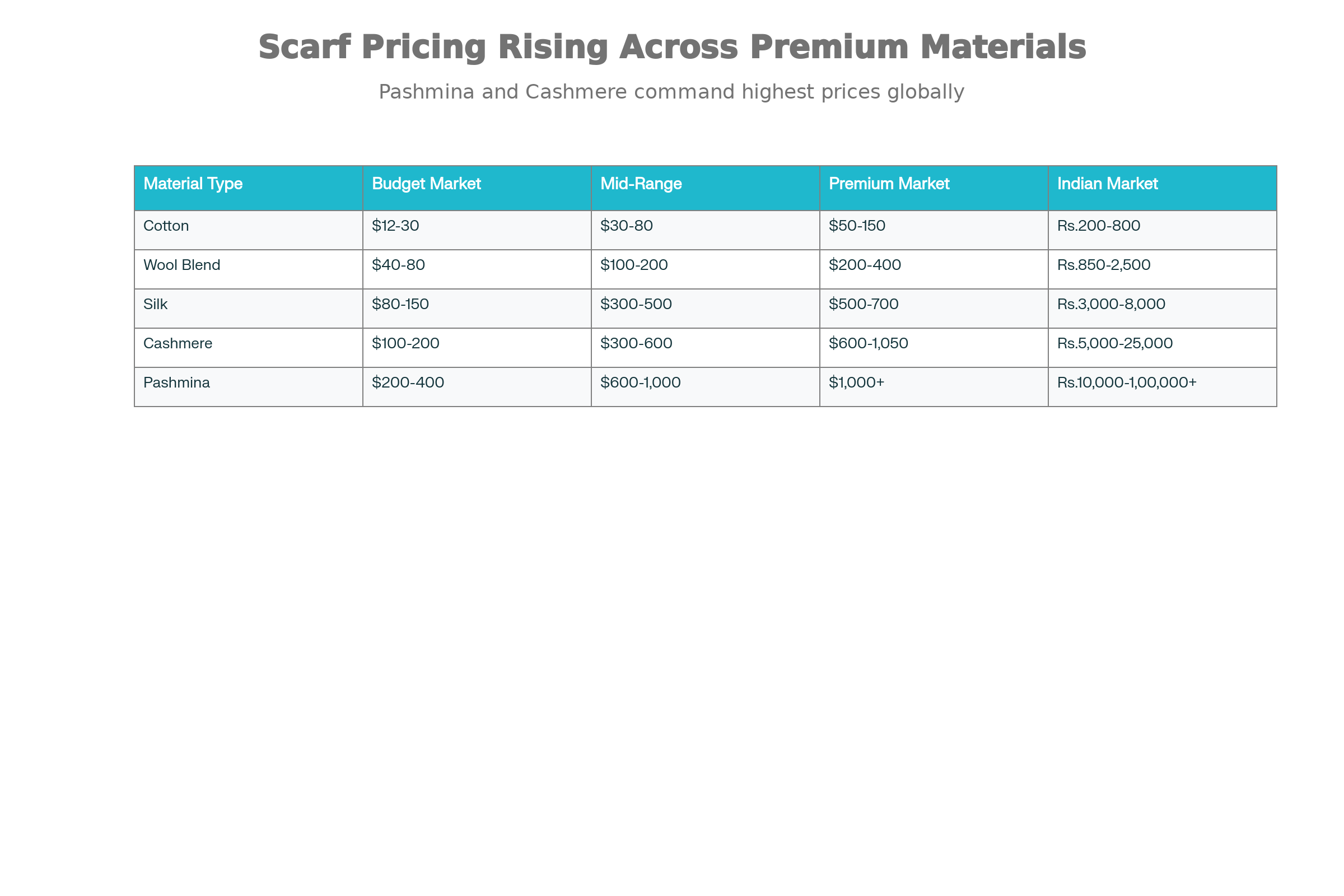
Comprehensive Scarf Pricing Guide by Material and Market Segment
Key Price Determinants
Brand Positioning
Designer and luxury brands command 300-500% markups over comparable quality non-branded items. A cashmere scarf from Hermès sells for $600-700, while functionally similar pieces from lesser-known manufacturers retail at $100-200.
Manufacturing Method
Hand-woven scarves, particularly those using traditional techniques like Kantha stitching or Kashmiri weaving, cost 5-10 times more than machine-produced alternatives. The labor-intensive process and artisanal positioning justify premium pricing.
Size and Weight
Larger stoles (70×200 cm) typically cost 30-50% more than smaller scarves (45×180 cm). Weight impacts material costs directly—heavier natural fibers command higher prices.
Embellishments and Design
Hand-dyed, block-printed, or embroidered scarves add 20-100% to base material costs. Limited-edition artist collaborations can increase prices exponentially.
Strategic Purchasing Insights for Your Business
For wholesale textile operations, India offers the most competitive sourcing globally. Direct manufacturer relationships eliminate middleman markups—typical retail-to-wholesale ratios are 4:1 to 6:1 across fabric types. Customization becomes economically viable at quantities as low as 100 pieces with no minimum order quantity from established suppliers.
The pashmina and hand-woven segments represent the highest-margin wholesale opportunities, with factory costs at ₹5,000-15,000 translating to retail prices of ₹25,000-1,00,000+ in international markets.

