
 French
  Deutsch
  Spanish
  الإمارات
  English
  Dutch
Dutch  English
 The scarf manufacturing industry has evolved significantly over the last decade as fashion brands, wholesalers, retailers, and private label businesses increasingly demand faster production, better customization, premium quality, and more flexible design options. Among the most widely used scarf printing methods today are hand screen printing and digital printing. Both techniques are highly effective, but each serves different production goals depending on design complexity, order quantity, fabric type, and overall brand positioning.
For businesses sourcing custom scarves, understanding the difference between these two printing methods is essential for balancing quality, cost, scalability, and creative flexibility. While hand screen printing continues to dominate large-volume production with bold and durable designs, digital printing has rapidly become the preferred solution for intricate artwork, low MOQ manufacturing, and fast-moving fashion collections.
As global fashion trends move toward customization, sustainability, and short-run production, both printing techniques remain important across different segments of the textile industry.
What Is Hand Screen Printing on Scarves?
Hand screen printing is a traditional textile printing technique where ink is manually applied onto fabric through stencil-based mesh screens. Each color in the design requires a separate silk screen, and ink is pushed through the screen using a squeegee, one layer at a time.
This process has been used for decades in textile manufacturing and remains highly popular for bulk scarf production.
Hand screen printing is commonly used for:
- Corporate gifting scarves
- Promotional scarves
- Fashion wholesale production
- Traditional textile collections
- Large-scale scarf manufacturing
Because the process requires separate screen preparation for every color, it is best suited for designs with limited color variations.
What Is Digital Printing on Scarves?
Digital printing is a modern, computer-driven textile printing method where artwork is printed directly onto fabric using advanced digital printers.
Unlike screen printing, digital printing transfers the entire design onto the fabric in a single process without requiring separate screens for each color.
This method works similarly to a desktop printer but on fabric rolls instead of paper.
Digital printing is widely used for:
- Luxury silk scarves
- Boutique fashion collections
- Personalized scarves
- Designer accessories
- Small-batch manufacturing
- Limited-edition products
The technology allows extremely detailed patterns, gradients, and multi-color artwork to be reproduced with exceptional precision.
Core Differences Between Hand Screen Printing and Digital Printing
| Aspect | Hand Screen Printing | Digital Printing |
|---|---|---|
| Printing Process | Stencil-based manual printing | Computer-driven direct printing |
| Design Complexity | Simple patterns and limited colors | Complex artwork and unlimited colors |
| MOQ Suitability | Economical for 100+ pieces | Ideal for small batches under 100 |
| Setup Cost | High due to screen preparation | Low setup cost |
| Color Matching | Excellent Pantone color accuracy | Excellent detailing and gradients |
| Production Speed | Slower setup and printing | Faster production and approvals |
| Fabric Feel | Slightly textured ink layer | Softer and smoother finish |
| Durability | Highly durable and vibrant | Good durability with softer finish |
| Best For | Bulk production | Customized and fashion-focused production |
Design Capability Comparison
Hand Screen Printing Works Best for Simple Bold Designs
Hand screen printing is highly effective for:
- Solid color artwork
- Repeat patterns
- Logo-based designs
- Traditional motifs
- Corporate branding
Because each color requires a separate screen, designs are usually limited to around three or four colors for cost efficiency.
This method is especially suitable for scarves requiring strong color vibrancy and consistent repeat production.
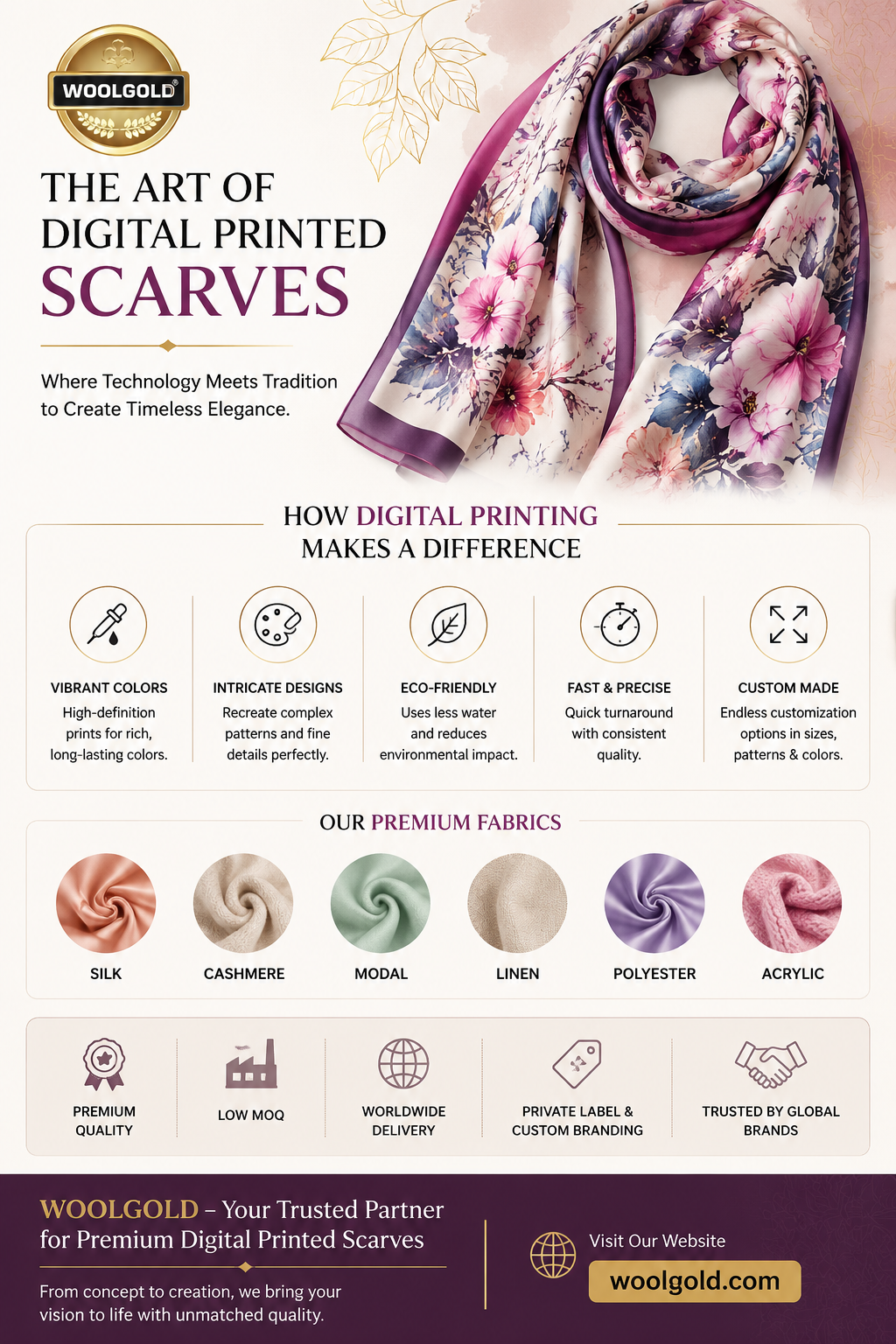
Digital Printing Excels at Complex Artwork
Digital printing allows fashion brands to create:
- Intricate illustrations
- Watercolor patterns
- Botanical artwork
- Abstract compositions
- Gradient effects
- Photographic detail
Since the design is printed directly from a digital file, there are virtually no limitations on color count or artistic complexity.
This makes digital printing ideal for modern luxury scarf collections.
MOQ and Production Economics
Hand Screen Printing Is Better for Bulk Orders
One of the biggest advantages of hand screen printing is scalability.
Once screens are prepared, large-volume production becomes highly cost-effective.
This method is ideal for:
- 100+ scarf orders
- Corporate gifting campaigns
- Wholesale production
- Uniform scarf programs
- Promotional events
Large runs reduce the per-unit cost significantly.
Digital Printing Supports Low MOQ Manufacturing
Digital printing requires little to no setup cost, making it highly suitable for:
- Small-batch production
- Fashion startups
- Design testing
- Boutique collections
- Limited editions
- Personalized scarves
Brands can launch new collections without investing heavily in inventory or screen setup.
This flexibility is one of the main reasons digital printing is growing rapidly in modern fashion manufacturing.
Color Accuracy and Visual Quality
Hand Screen Printing Provides Vibrant Color Strength
Hand screen printing allows manufacturers to mix custom inks precisely, including exact Pantone™ color matching.
This is especially important for:
- Corporate branding
- Promotional products
- Uniform production
- Brand consistency
The ink layer is often thicker, resulting in bold and long-lasting color appearance.
Digital Printing Delivers Photographic Precision
Digital printing offers exceptional detail reproduction with unlimited colors and smooth gradients.
This technique is perfect for:
- Artistic fashion scarves
- Luxury retail products
- Fashion-forward collections
- Designer collaborations
Digital prints appear highly refined, especially on silk, modal, and lightweight luxury fabrics.

Fabric Feel and Texture
Hand Screen Printing Creates a Richer Texture
Because screen printing applies a thicker ink layer onto the fabric surface, the final scarf often has:
- Slight texture
- Strong color depth
- Artisan appearance
Many traditional fashion brands value this handcrafted feel.
Digital Printing Creates a Softer Finish
Digital printing allows the ink to adhere more naturally to fabric fibers.
This creates:
- Softer texture
- Lightweight drape
- Flexible feel
- Smooth finish
Luxury scarf brands often prefer digital printing because it preserves the softness of premium fabrics such as silk and modal.
Lead Time and Production Speed
Screen Printing Requires Longer Setup
Hand screen printing involves:
- Screen preparation
- Color separation
- Multi-stage printing
This increases production preparation time, especially for multi-color designs.
Digital Printing Offers Faster Turnaround
Digital printing allows faster:
- Sampling
- Design approvals
- Production setup
- Collection launches
This speed is especially valuable for fast-moving fashion markets.
Durability Comparison
Hand Screen Printing Offers Strong Long-Term Color Durability
Screen-printed scarves often maintain vibrant color appearance for longer periods due to thicker ink application.
This makes them highly suitable for:
- Repeated use
- Commercial production
- Long-term promotional products
Digital Printing Focuses More on Detail and Softness
Modern digital printing technologies provide strong durability, although some fabrics may experience slightly softer color intensity over time compared to traditional screen printing.
However, the superior detail and luxury finish often outweigh this difference in premium fashion markets.
When to Choose Hand Screen Printing
Choose hand screen printing if:
- You need 100+ scarves
- Designs use limited colors
- Exact Pantone color matching is important
- Durability is a top priority
- Production is focused on large-scale wholesale or corporate gifting
This method remains highly effective for bold, repeatable commercial scarf programs.
When to Choose Digital Printing
Choose digital printing if:
- You need fewer than 100 pieces
- Designs include gradients or detailed artwork
- Fast production is important
- You want personalized collections
- You are testing new scarf designs
Digital printing is especially valuable for boutique fashion brands and trend-focused collections.
Modern Fashion Trends Favor Both Methods
Today, many successful scarf brands use both printing techniques strategically.
For example:
- Screen printing for bulk corporate gifting
- Digital printing for designer collections
- Screen printing for promotional programs
- Digital printing for luxury retail scarves
Using both methods allows brands to balance scalability, creativity, and profitability.
Key Takeaway for Textile Businesses
For B2B textile manufacturing businesses, both printing methods offer strong commercial value depending on the target market.
Hand Screen Printing
Best for:
- Large corporate gifting orders
- Promotional scarf campaigns
- Simple bold designs
- Volume-based production
Digital Printing
Best for:
- Boutique fashion orders
- Artistic scarf collections
- Botanical and abstract designs
- Limited-edition collections
- Small-batch production
As fashion trends in 2026 continue moving toward personalization and creative expression, digital printing is becoming increasingly important for premium scarf manufacturing.
Conclusion
Hand screen printing and digital printing both play essential roles in modern scarf manufacturing. Hand screen printing remains the preferred solution for large-scale production, strong color durability, and cost-effective bulk manufacturing. Digital printing, on the other hand, offers unmatched design flexibility, low MOQ production, faster turnaround, and highly detailed artistic capabilities.
The best choice depends on production goals, design complexity, target audience, and brand positioning. Many successful fashion businesses combine both methods to serve different customer segments while maximizing scalability and creative potential.
As the global scarf industry continues evolving, both hand screen printing and digital printing will remain key technologies driving innovation in fashion accessories manufacturing.
Premium Scarf & Fashion Manufacturing Solutions by Woolgold
At Woolgold, we manufacture and export premium-quality scarves, shawls, throws, blankets, abayas, kaftans, cord sets, men’s and women’s clothing, and luxury fashion accessories for global brands and wholesalers.
We specialize in custom manufacturing, private label production, hand and digital printing, embroidery work, luxury fabrics, low MOQ orders, bulk wholesale supply, and corporate gifting solutions. From boutique collections to large-scale retail programs, we provide reliable production support with worldwide delivery and premium-quality craftsmanship tailored for international markets.

