French
  Deutsch
  Spanish
  الإمارات
  English
 Placing a first bulk shawl order can feel complicated when a buyer is unfamiliar with textile manufacturing. There are fabric choices to make, quantities to determine, samples to approve, prices to negotiate, branding requirements to finalize, and international shipping arrangements to understand.
For boutiques, fashion brands, wholesalers, hotels, spas, corporate gifting companies, and private-label businesses, the process becomes much easier when every requirement is defined before production begins.
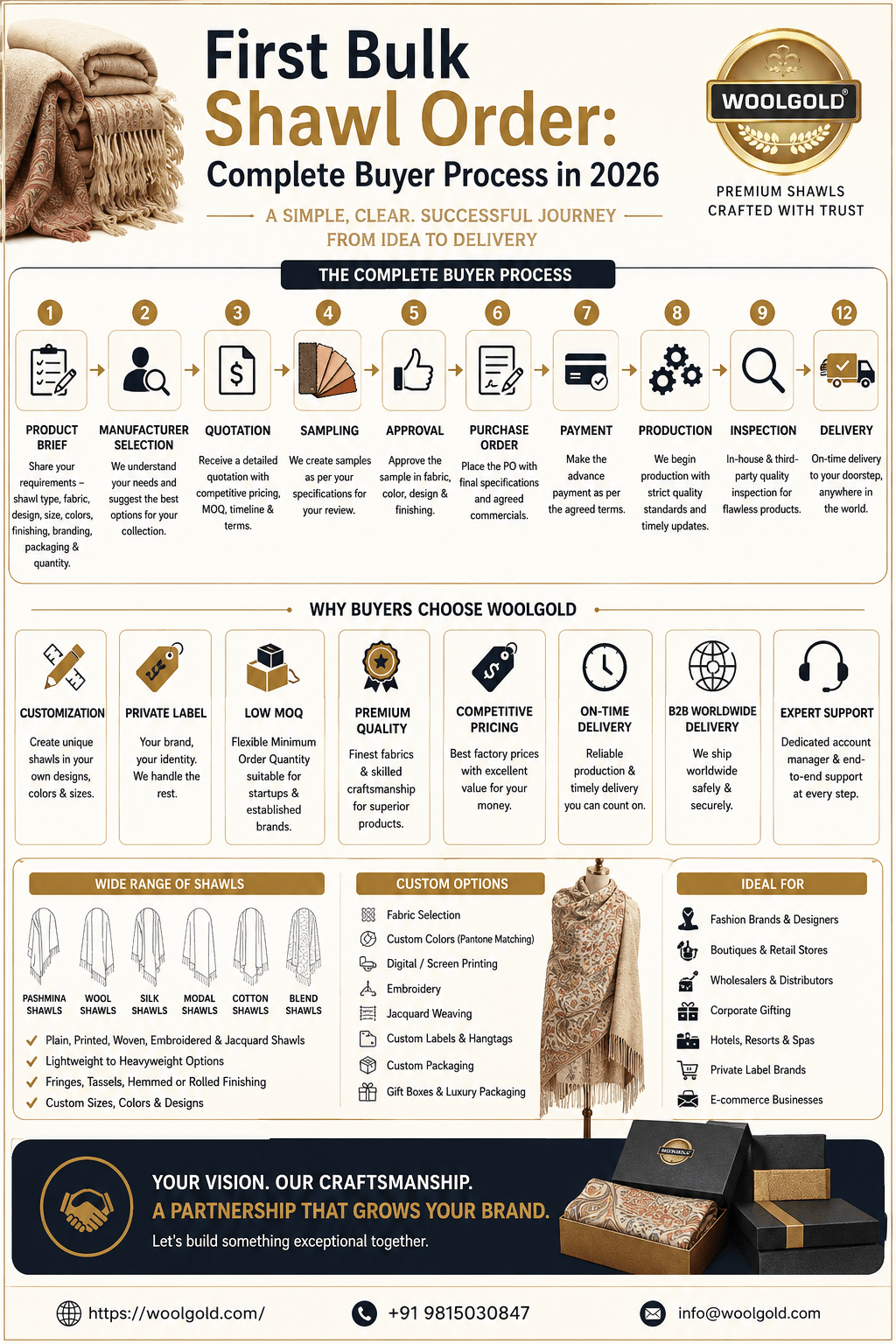
A successful bulk shawl order generally follows this path:
Product brief → Manufacturer selection → Quotation → Sampling → Approval → Purchase order → Payment → Production → Inspection → Packaging → Shipping → Delivery
This guide explains each stage so first-time buyers can approach a shawl manufacturer or wholesale shawl supplier with greater confidence.
1. Define Your Shawl Requirements Before Contacting a Manufacturer
The first step is creating a clear product specification.
A manufacturer can provide a much more accurate quotation when the buyer already knows what type of shawl is required.
Your product brief should cover:
- Shawl type: winter shawl, fashion shawl, stole, wrap, blanket shawl, or scarf
- Fabric: cashmere, pashmina, merino wool, silk, modal, cotton, viscose, acrylic, or blend
- Dimensions: length, width, and approximate weight
- Construction: woven, knitted, handwoven, printed, embroidered, or jacquard
- Design: plain, floral, paisley, geometric, checked, striped, or custom artwork
- Colors: Pantone references, physical swatches, or approved artwork
- Finishing: fringe, tassels, hemmed edges, rolled edges, or decorative borders
- Quantity: total pieces and quantity per color/design
- Branding: woven label, hangtag, care label, barcode, logo, or packaging
- Packaging: bulk cartons, individual polybags, paper sleeves, gift boxes, or luxury packaging
For example, instead of simply asking for “1,000 custom shawls,” a buyer could provide:
1,000 lightweight modal shawls, 70 × 200 cm, digitally printed floral artwork, rolled edges, custom woven label, individual paper sleeve, packed in export cartons.
This level of detail reduces misunderstandings between the buyer and manufacturer.
2. Decide Which Fabric Is Right for Your Shawl Collection
Fabric selection affects almost every aspect of the final product, including price, weight, softness, warmth, drape, appearance, care requirements, and retail positioning.
Cashmere
Suitable for premium and luxury collections where softness, warmth, and perceived value are priorities.
Pashmina
Well suited to heritage-inspired, luxury, and premium shawl collections.
Merino Wool
A strong choice for premium winter collections requiring softness and warmth.
Silk
Ideal for lightweight luxury shawls, occasionwear, gifting, resort collections, and printed designs.
Modal
Useful for soft, lightweight, draping shawls and fashion-focused collections.
Cotton
Suitable for breathable, everyday, summer, travel, and easy-care products.
Viscose
A versatile option for soft, flowing, colorful fashion shawls.
Wool Blends
Useful when the buyer wants a balance between warmth, performance, design flexibility, and price.
The right choice ultimately depends on the target customer and intended retail price, rather than simply selecting the most expensive fibre.
3. Choose the Right Shawl Manufacturer
Choosing the manufacturer is one of the most important decisions in the entire process.
The lowest quotation does not necessarily represent the lowest overall cost. A supplier that produces inconsistent quality, misses deadlines, or cannot reproduce an approved design can create considerably higher costs later.
When evaluating a manufacturer, ask:
- Do you manufacture the shawls directly?
- Which fabrics can you produce?
- What printing methods are available?
- Can you handle embroidery?
- Do you offer jacquard weaving?
- What is your MOQ?
- Can you produce custom colors?
- Can you develop private-label products?
- Can you create samples?
- What is the estimated sample timeline?
- What is the bulk-production timeline?
- Do you provide quality inspection?
- Do you have experience with international shipments?
- Can you provide product specifications and care information?
It is also useful to request appropriate evidence of manufacturing capabilities, such as photographs or videos of:
- Fabric production
- Printing
- Weaving
- Embroidery
- Finishing
- Label application
- Packaging
- Carton packing
For a first order, clear communication and documented specifications are often more valuable than simply finding the lowest price.
4. Ask About MOQ Before Developing the Collection
MOQ means Minimum Order Quantity.
Every manufacturer has different MOQ requirements depending on the material, construction, printing method, design complexity, and production process.
For example, the MOQ may be different for:
- Plain wool shawls
- Custom digital-print silk
- Embroidered pashmina
- Custom jacquard
- Private-label packaging
- Custom-dyed fabric
A buyer should ask for MOQ at the beginning rather than developing an entire collection and discovering later that the required quantity is too small.
For emerging brands and boutiques, low-MOQ shawl manufacturing can be particularly valuable because it allows the business to test designs before committing to large inventory quantities.
5. Request a Detailed Shawl Quotation
A professional quotation should contain more than a single price per piece.
Request a written quotation covering:
- Product description
- Fabric composition
- Dimensions
- Approximate weight
- Quantity
- Unit price
- Sampling charges
- Customization charges
- Label costs
- Packaging costs
- Production lead time
- Payment terms
- Shipping terms
- Quotation validity
- Destination
- Applicable taxes or other charges
Compare Landed Cost, Not Just Factory Price
Suppose a hypothetical quotation looks like this:
| Cost Component | Example |
|---|---|
| Shawl manufacturing | ₹450 |
| Custom label | ₹12 |
| Individual packaging | ₹25 |
| Handling/inspection | ₹8 |
| Freight allocation | ₹55 |
| Estimated cost before local taxes | ₹550 |
These figures are illustrative only, not a market quotation.
Actual costs depend on order quantity, destination, shipping method, currency, duties, packaging, and negotiated commercial terms.
The important point is to compare the total landed cost rather than selecting a supplier based solely on factory price.
6. Order Samples Before Placing the Bulk Shawl Order
A sample is one of the most important stages of the process.
Do not approve a significant bulk order based only on photographs if fabric quality, color, drape, or finishing is important to the product.
A sample allows the buyer to evaluate:
- Fabric softness
- Thickness
- Weight
- Warmth
- Drape
- Color
- Print quality
- Embroidery
- Dimensions
- Border alignment
- Fringe
- Stitching
- Label placement
- Packaging
For custom production, buyers can request a pre-production sample or appropriate color/artwork approvals before bulk manufacturing.
7. Create a Formal Sample Approval
Once the sample is received, record exactly what has been approved.
The approved reference can include:
- Sample number
- Date
- Fabric composition
- Dimensions
- Weight
- Color reference
- Artwork version
- Finishing details
- Label position
- Packaging specifications
For a first bulk order, keeping an approved physical sample is highly useful.
The final production should be manufactured according to the approved specification and agreed tolerances.
8. Confirm Color and Artwork Carefully
Color discrepancies can become particularly noticeable in fashion accessories.
For custom shawls, buyers should provide the manufacturer with the best available reference, such as:
- Pantone reference
- Physical fabric swatch
- Approved lab dip
- High-resolution artwork
- Color specification
Digital artwork displayed on different monitors can appear different from the final physical product.
For printed shawls, confirm:
Artwork size → Repeat → Placement → Border → Color → Scale → Print method
before production.
9. Finalize the Purchase Order
Once the sample and quotation are approved, the buyer should issue a purchase order or sales contract containing the complete technical and commercial requirements.
Include:
- Buyer and seller details
- Product codes
- Product specifications
- Quantity
- Color breakdown
- Design breakdown
- Unit price
- Total value
- Currency
- Payment schedule
- Sample approval reference
- Production deadline
- Quality requirements
- Packaging instructions
- Shipping terms
- Delivery destination
- Required documents
- Procedure for defects or shortages
Important approvals should not exist only inside informal messaging.
Use a formal purchase order or email confirmation so there is a clear record of the agreed specifications.
10. Understand Payment Terms
Payment terms should be finalized before manufacturing starts.
Depending on the supplier, order size, and commercial relationship, arrangements can include:
- Full advance payment
- Deposit + balance before dispatch
- Deposit + balance after inspection
- Letter of credit
- Other agreed trade-finance arrangements
For a first international order, buyers should carefully verify payment details.
Before transferring funds, confirm:
- Supplier’s legal/business name
- Proforma invoice
- Beneficiary details
- Bank information
- Order value
- Currency
- Payment schedule
If a supplier sends revised bank details unexpectedly, independently verify the change before making payment.
11. Confirm Production Lead Time
Production timelines vary considerably.
Factors include:
- Fabric availability
- Yarn availability
- Order quantity
- Design complexity
- Printing requirements
- Embroidery
- Jacquard production
- Packaging
- Seasonal demand
A buyer should request a realistic production schedule rather than relying on a general statement such as “delivery in a few weeks.”
For custom shawls, the timeline may include:
Raw material → Fabric production → Dyeing/printing → Embroidery/weaving → Finishing → Labeling → Packaging → Inspection → Dispatch
12. Monitor Production Progress
For larger orders, buyers can request milestone updates.
A typical production sequence may look like:
- Raw material approval
- Fabric sourcing or production
- Dyeing or printing
- Weaving/embroidery
- Cutting and finishing
- Label application
- Packaging
- Final inspection
- Carton packing
- Dispatch
Photographs and videos can provide useful progress information, although they should not replace a proper inspection where one is commercially necessary.
13. Complete Quality Inspection Before Dispatch
Quality control is particularly important for a first bulk order.
The inspection should cover:
| Area | What to Check |
|---|---|
| Quantity | Pieces, cartons, colors and designs |
| Fabric | Composition, weight, holes, stains and defects |
| Color | Consistency with approved reference |
| Sharpness, placement and repeat | |
| Dimensions | Length, width and agreed tolerance |
| Finishing | Hems, stitching, fringe and tassels |
| Embroidery | Motif, thread, density and placement |
| Branding | Labels, hangtags and care labels |
| Packaging | Individual packaging and carton markings |
The buyer and supplier should agree beforehand on acceptable tolerances and how defects will be handled.
14. Finalize Packaging and Branding
Packaging can be particularly important for private-label shawls.
Depending on the retail position, buyers can request:
Basic Wholesale Packaging
- Folded shawl
- Individual polybag
- Export carton
Premium Retail Packaging
- Paper sleeve
- Branded label
- Hangtag
- Tissue
- Sticker
Luxury Gifting Packaging
- Branded box
- Tissue paper
- Ribbon
- Product card
- Custom insert
Packaging should be specified before production because it can affect both MOQ and cost.
15. Understand International Shipping Terms
For international orders, buyers need to understand which party is responsible for transportation, insurance, customs clearance, duties, and delivery.
Common commercial terms include:
| Term | General Concept |
|---|---|
| EXW | Buyer takes responsibility from the seller’s premises |
| FCA | Seller delivers to the agreed carrier/place |
| FOB | Seller delivers goods on board at the named port |
| CIF | Seller arranges cost, freight and basic insurance to the destination port |
| DAP | Seller delivers to the agreed destination, with import clearance generally handled by the buyer |
| DDP | Seller arranges delivery including import clearance and duties, where feasible |
The exact responsibilities depend on the specific Incoterm and named place used in the contract.
For international orders, always specify the term and location clearly rather than writing only “FOB” or “DAP.”
16. Prepare the Required Export Documents
Depending on the destination and shipment structure, the buyer may need documents such as:
- Commercial invoice
- Packing list
- Transport document
- Certificate of origin where applicable
- Product/fabric documentation
- Insurance documentation where applicable
- Other destination-specific customs documents
Requirements vary by destination, product composition, and trade arrangement.
The buyer should confirm import requirements with the relevant customs authority or logistics provider before shipment.
17. Receive and Check the Shawl Shipment
When the order arrives, do not immediately distribute everything to stores or customers.
First check:
- Carton quantity
- Product quantity
- Product condition
- Colors
- Designs
- Dimensions
- Labels
- Packaging
- Visible defects
It is useful to retain several pieces from the first shipment as reference samples for future reorders.
18. Record What Worked for the First Order
The first order should become a reference point for future production.
Maintain records of:
- Fabric specification
- GSM/weight where relevant
- Dimensions
- Color references
- Artwork files
- Print specifications
- Embroidery files
- Label specifications
- Packaging
- Approved sample
- Supplier quotation
- Purchase order
- Final inspection
- Shipping documents
This makes future reorders significantly easier.
Common Mistakes First-Time Shawl Buyers Should Avoid
1. Choosing Only on Price
The cheapest quotation can become expensive if the quality is inconsistent or production is delayed.
2. Not Ordering a Sample
A photograph cannot fully communicate fabric hand-feel, weight, drape, or finishing.
3. Giving Vague Specifications
“Premium shawl” is not a technical specification.
Define the material, size, weight, design, color, finishing, and packaging.
4. Ignoring Packaging Costs
Private-label packaging can significantly change the final cost.
5. Not Confirming MOQ
Ask about minimum quantities before finalizing the collection.
6. Approving Artwork Too Quickly
Review print scale, repeat, colors, borders, and placement carefully.
7. Not Defining Quality Tolerances
Manufacturing naturally involves certain tolerances. Agree on acceptable limits before production.
8. Forgetting the Total Landed Cost
Freight, duties, packaging, taxes, and local charges can change the economics of an order.
9. Making Payment Without Verification
Always verify supplier and bank details before transferring funds.
10. Changing Specifications During Production
Late changes can cause additional costs, delays, or inconsistent products.
First Bulk Shawl Order: Buyer Checklist
Before approving production, confirm all of the following:
Product
- Shawl type selected
- Fabric confirmed
- Composition confirmed
- Dimensions confirmed
- Weight/GSM confirmed where applicable
- Construction confirmed
Design
- Artwork approved
- Colors approved
- Print placement approved
- Embroidery approved
- Border approved
- Fringe/finishing approved
Branding
- Woven label approved
- Hangtag approved
- Care label approved
- Packaging approved
- Barcode requirements confirmed
Commercial
- MOQ confirmed
- Unit price confirmed
- Total quantity confirmed
- Payment terms confirmed
- Production timeline confirmed
- Shipping term confirmed
Quality
- Sample approved
- Quality standards documented
- Tolerances agreed
- Inspection process confirmed
Shipping
- Delivery address confirmed
- Carton requirements confirmed
- Export documents confirmed
- Freight arrangement confirmed
How to Make Your First Bulk Shawl Order Easier
The simplest approach is to treat the order as a product-development project rather than simply a purchase.
Start with a clear specification. Select a manufacturer that can actually produce the required construction. Request a sample. Approve every important detail in writing. Confirm the purchase order and payment terms. Monitor production. Inspect the finished goods. Then arrange shipment according to the agreed commercial terms.
This process reduces misunderstandings and gives both the buyer and manufacturer a clear reference throughout production.
First Bulk Shawl Orders With Woolgold
Woolgold supports B2B shawl manufacturing for fashion brands, boutiques, wholesalers, retailers, designers, corporate gifting companies, and private-label businesses.
We manufacture shawls in cashmere, pashmina, wool, merino wool, silk, modal, viscose, cotton, and blended fabrics, with customization available across designs, colors, dimensions, printing, embroidery, jacquard weaving, borders, fringes, labels, hangtags, and packaging.
Our manufacturing capabilities support both fashion-led and luxury shawl collections, from lightweight printed silk and modal styles to premium wool, cashmere, and pashmina products.
For first-time buyers, the process can begin with the product brief and sample development, followed by quotation, specification approval, bulk manufacturing, quality control, private labeling, packaging, and international delivery.
With low-MOQ options for selected products, custom manufacturing, private labeling, premium materials, and worldwide B2B shipping, Woolgold provides a complete production solution for businesses placing their first bulk shawl order.
Request a Custom Bulk Shawl Quotation
If you are preparing your first bulk shawl order, provide the manufacturer with your preferred fabric, dimensions, quantity, design, target price, branding requirements, packaging, and delivery destination.
A detailed product brief allows Woolgold to recommend suitable manufacturing options and prepare a more accurate quotation for your collection.
From the first sample to bulk production and worldwide delivery, Woolgold helps fashion brands, boutiques, retailers, wholesalers, and private-label businesses turn their shawl concepts into finished products ready for the market.